
Calculate CBM from Inches & Centimeters: Freight Guide

Quick Answer:
To calculate CBM from centimeters, multiply length × width × height (in cm) and divide by 1,000,000. To calculate CBM from inches, multiply length × width × height (in inches) and divide by 61,023.7.
When sourcing products internationally, one of the most immediate math challenges importers face is dealing with mixed measurement systems. Overseas factories in China or Europe provide carton dimensions in centimeters (cm), while North American warehouses operate in inches (in). Knowing how to quickly calculate CBM from centimeters and calculate CBM from inches ensures you never miscalculate ocean freight quotes or container space.
Why Unit Conversion Errors Cost Money in Freight Shipping
International sea freight is quoted almost universally in metric CBM (Cubic Meters). If a seller incorrectly converts 20 inches to 0.20 meters instead of 0.508 meters, their calculated volume will be severely off. A 60% underestimation in CBM leads to unexpected re-measurement fees, port demurrage, or having left-over pallets stuck at the origin port warehouse because the container overflowed.
How to Calculate CBM from Centimeters (cm to CBM)
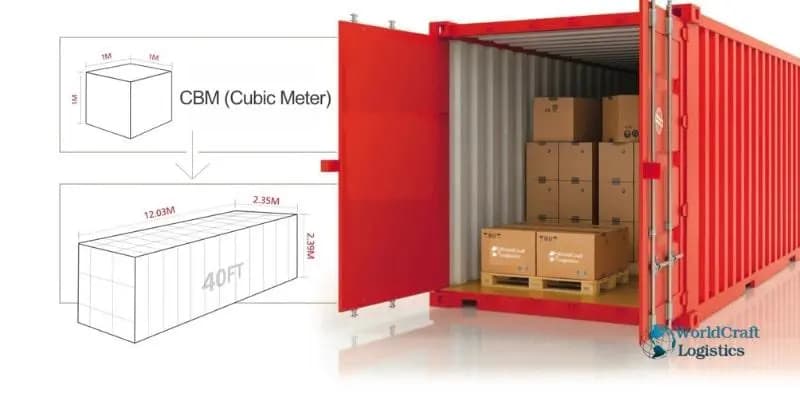
Because 1 meter equals 100 centimeters, 1 cubic meter equals 100 × 100 × 100 = 1,000,000 cubic centimeters. This makes converting centimeters to CBM straightforward.
Centimeters to CBM Calculation Formula
CBM = [Length (cm) × Width (cm) × Height (cm)] ÷ 1,000,000 × Quantity
Example: Suppose you have 80 boxes measuring 50 cm long, 40 cm wide, and 30 cm tall:
- Single box volume = 50 × 40 × 30 = 60,000 cm³.
- Single box CBM = 60,000 ÷ 1,000,000 = 0.06 CBM.
- Total shipment CBM = 0.06 × 80 boxes = 4.8 CBM.
How to Calculate CBM from Inches (inches to CBM)
To calculate CBM inches, we rely on the imperial conversion constant. Since 1 inch equals 0.0254 meters, 1 cubic inch equals 0.000016387064 m³. Reversing this gives 1 CBM = 61,023.7 cubic inches.
Inches to CBM Calculation Formula
CBM = [Length (in) × Width (in) × Height (in)] ÷ 61,023.7 × Quantity
Example: An Amazon FBA seller has 100 master cartons measuring 20 inches long, 15 inches wide, and 10 inches high:
- Single box volume = 20 × 15 × 10 = 3,000 cubic inches.
- Single box CBM = 3,000 ÷ 61,023.7 = 0.04916 CBM.
- Total shipment CBM = 0.04916 × 100 = 4.916 CBM.
CBM Quick Reference & Conversion Lookup Table
The table below provides instant CBM estimates for standard box dimensions commonly used in e-commerce and retail supply chains:
| Box Dimensions (cm) | Box Dimensions (inches) | CBM per Box | Boxes per 1 CBM |
|---|---|---|---|
| 30 × 20 × 15 cm | 11.8 × 7.9 × 5.9 in | 0.009 CBM | ~111 boxes |
| 40 × 30 × 20 cm | 15.7 × 11.8 × 7.9 in | 0.024 CBM | ~41 boxes |
| 50 × 40 × 30 cm | 19.7 × 15.7 × 11.8 in | 0.060 CBM | ~16 boxes |
| 60 × 40 × 40 cm | 23.6 × 15.7 × 15.7 in | 0.096 CBM | ~10 boxes |
Common Unit Conversion Pitfalls & How to Avoid Shipping Surcharges
To keep your shipping calculations accurate, watch out for these frequent mistakes when converting measurements to CBM:
- Mixing Feet and Inches: If a box is 2 feet by 18 inches by 1 foot, convert all units to inches (24 in × 18 in × 12 in) or meters (0.61m × 0.457m × 0.305m) before multiplying.
- Forgetting Outer Packing Bulge: Always measure the widest exterior points of a taped carton, including handles, corner guards, or bulging sides. A 1 cm measurement error on 500 cartons can alter your final freight bill by over half a cubic meter!
- Ignoring Pallet Base Volume: Standard ISO or wooden pallets add roughly 0.15 to 0.20 CBM of volume per pallet stack.
Freight Forwarder & Ecommerce Community Advice from Reddit
In community discussions on calculators and FulfillmentByAmazon, freight experts stress using verified conversion formulas.
As user logistics_guru writes: "When calculating CBM from inches, don't round down your conversion factor. Dividing by 61,000 instead of 61,023.7 might seem tiny on one box, but across a 1,000-carton shipment, that rounding error adds up to noticeable discrepancies when your freight forwarder audits the cargo on their laser dimensioning machine."
In addition, users on SupplyChainLogistics recommend bookmarking an online CBM calculator to cross-check supplier proforma invoice estimates before submitting payment for sea freight bookings.
Sources and Community References
- Reddit calculators cubic meter discussion: calculators - Cubic Meter Math Thread
- Reddit SupplyChainLogistics shipping guide: SupplyChainLogistics - CBM Volume vs Weight
- Reddit FulfillmentByAmazon software thread: FulfillmentByAmazon - Carton Dimensioning & CBM
Atlas Keller's editorial scope covers Infinix material-volume, coverage, and construction planning content. Quantities and costs are estimates, not engineering specifications or supplier quotes.