
Infinix Calculators
Construction & Materials

Concrete Calculator

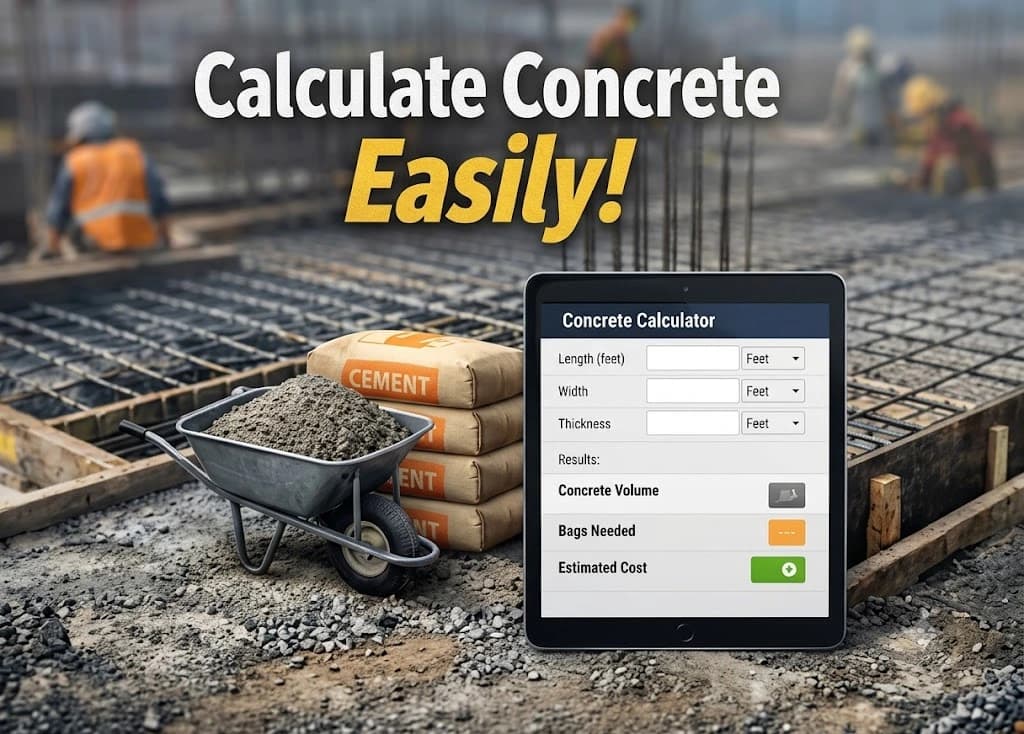
Free concrete calculator for slabs, footings, patios & steps. Calculate cubic yards, ready-mix price per yard, and how many 80lb/60lb bags of concrete you need instantly.

Interactive Calculator

1. Provide Details

ft
ft
in

2. Output Results

Volume (Cubic Yards)1.78 cu yd
Volume (Cubic Feet)48.00 cu ft
80 lb Pre-mix Bags80 bags
60 lb Pre-mix Bags107 bags

How to Calculate: Formula & Steps

Finds the cubic volume of a rectangular slab or cylinder in cubic feet, converts it to cubic yards by dividing by 27, and calculates bags by dividing volume by the yield of the selected bag size.

Formula Used:Slab: Volume = Length × Width × Thickness | Column: Volume = π × Radius² × Depth

Step-by-Step Calculation Example

A rectangular slab 12ft × 12ft at 4 inches thick needs 1.78 cubic yards. This requires forty-five 80 lb bags or sixty 60 lb bags of concrete.

Inputs and Assumptions

Enter values that match your project or situation. The calculator uses the following fields and defaults; update them before relying on the estimate.

Length (Feet)
Default: 12 ft
Width (Feet)
Default: 12 ft
Thickness (Inches)
Default: 4 in

Common Mistakes to Avoid

  • Not accounting for slab thickness variations across uneven ground.

Practical Use Cases

  • Patio and driveway slab pour planning
  • Fence post footings

Expert Tips

  • Rent a concrete mixer for pours over 20 bags to save time and effort.

How to Calculate Concrete Volume: Slabs, Walls, and Footings

Estimating concrete requirements accurately is the difference between a successful pour and an expensive, half-finished mess. Whether you are ordering a ready-mix delivery truck in cubic yards or purchasing individual pre-mix bags from local home improvement stores, using a concrete calculator guarantees precise volume planning and saves you from costly over-ordering or under-ordering.

Concrete volume is calculated in cubic feet by multiplying the surface area of the pour by its thickness (converted to feet), then dividing by 27 to obtain the volume in cubic yards. This free concrete slab cost calculator helps homeowners and contractors determine exactly how much material they need for driveways, patios, foundations, and walkways.

Concrete Bags to Cubic Yards Quick Lookup Chart

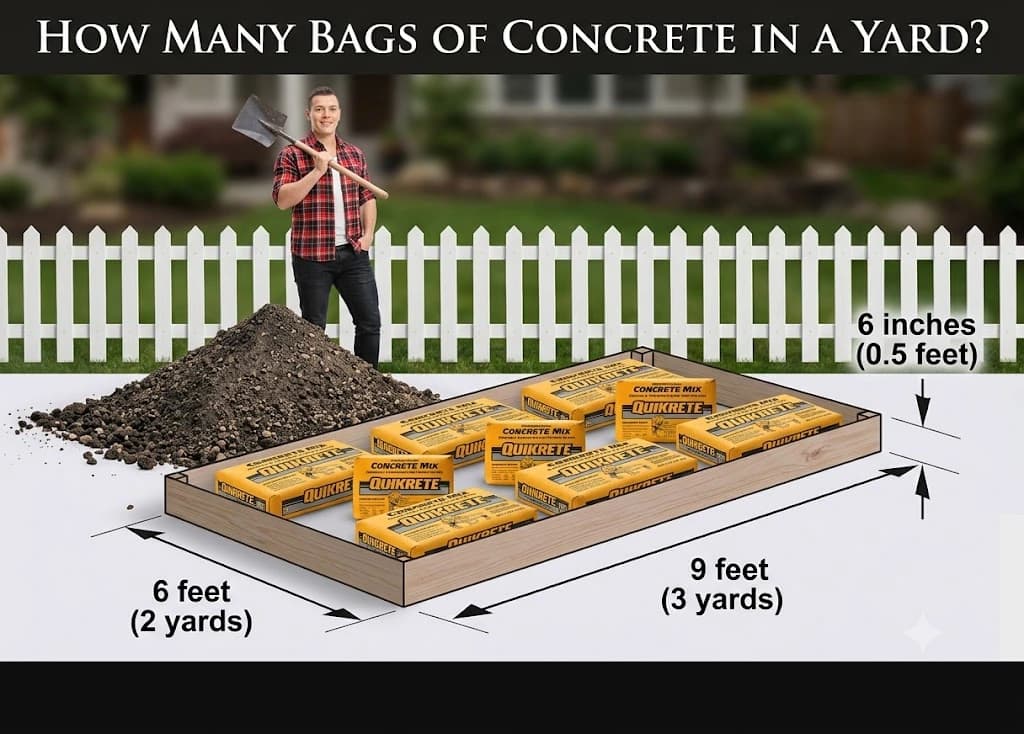
How many bags of concrete do you need to equal a cubic yard? Use this reference table for standard pre-mix bag yields:

Bag Weight (lbs)Volume Yield (cu ft)Bags per Cubic Yard (27 cu ft)
80 lb bag0.60 cu ft45 Bags
60 lb bag0.45 cu ft60 Bags
40 lb bag0.30 cu ft90 Bags

*Note: Bag yields are approximate and depend on the amount of water mixed. Always add a 10% waste buffer to account for spills, settling, and subgrade variations.

Rectangular Slabs Formula

Volume (cu ft) = Length (ft) × Width (ft) × [Thickness (in) ÷ 12]

Use this formula for square or rectangular shapes, including driveways, garden pathways, home foundation slabs, patio floors, and retaining walls.

Circular Columns & Piers Formula

Volume (cu ft) = π × Radius² (ft) × Height/Depth (ft)

Use this formula for circular concrete tube forms (e.g., Sonotubes), structural columns, deck post footings, circular fire pits, and support piers.

Concrete Slab Thickness Guidelines

Selecting the appropriate thickness ensures structural durability. Below are industry-standard thicknesses for residential concrete pours:

  • Walkways & Sidewalks (4 inches): Perfect for foot traffic, trash can storage, and general garden walkway surfaces.
  • Patios & Hot Tub Pads (4 inches): Standard for standard outdoor seating. If supporting heavy swim spas, consider thick 5-6 inch bases with rebar reinforcing.
  • Residential Driveways (5–6 inches): Required for passenger vehicles and light trucks. Standard 4-inch pours can easily crack under vehicle weights or temperature expansion.
  • Heavy Equipment / Dump Truck Areas (6+ inches): Commercial yards and loading zones require thick slabs with internal steel reinforcement.

Concrete Slab Cost Per Square Foot (2026 Pricing Guide)

Understanding concrete slab cost helps you budget accurately. Here are current national average prices for concrete installation:

Project TypeThicknessCost per Sq FtTypical Total Cost
Patio / Walkway4 inches$6 - $9$600 - $1,800 (200 sq ft)
Driveway5-6 inches$8 - $12$2,400 - $6,000 (600 sq ft)
Foundation Slab6 inches$10 - $15$10,000 - $18,000 (1,200 sq ft)

Prices vary by region, reinforcement needs, and local labor rates. Use our calculator above to get your precise volume, then multiply by your local per-yard rate.

Step-by-Step: Calculating Concrete for a 20×24 ft Driveway

Step 1: Measure the driveway area — 20 ft (length) × 24 ft (width) = 480 sq ft.

Step 2: Convert thickness to feet — 5 inches ÷ 12 = 0.417 ft.

Step 3: Calculate cubic feet — 480 sq ft × 0.417 ft = 200 cubic feet.

Step 4: Convert to cubic yards — 200 cu ft ÷ 27 = 7.4 cubic yards.

Step 5: Add 10% waste buffer — 7.4 × 1.10 = 8.15 cubic yards (order 8.25 to be safe).

At $150/yard delivered, this driveway costs approximately $1,238 for materials alone.

Common Concrete Estimating Mistakes to Avoid

  • Forgetting the waste factor: Always add 10-15% for spillage, subgrade settling, and over-excavation.
  • Mixing up inches and feet: Convert all measurements to feet before calculating volume.
  • Ignoring reinforcement: Rebar or wire mesh adds minimal volume but is essential for structural integrity.
  • Not checking minimum delivery: Most ready-mix trucks require a minimum of 3-4 cubic yards. Small projects may need bagged concrete instead.

Related Resources:

Disclaimer

This calculation tool is provided for educational and informational estimation purposes only. Results are based on mathematical formulas and user-supplied parameters. They do not constitute formal underwriting, financial, tax, engineering, or legal determinations.

Frequently Asked Questions About Concrete Calculator

How do I calculate how much concrete I need for a slab, patio, or driveway?
To calculate concrete yardage for a rectangular slab, multiply Length (feet) × Width (feet) × Thickness (depth in inches ÷ 12) to find total cubic feet, then divide by 27 to convert into cubic yards. Always add a 10% safety margin for ground irregularities and spillage: Cubic Yards = (Length × Width × (Depth / 12)) ÷ 27 × 1.10. Use our free Concrete Yard Calculator for instant calculations.
How many bags of concrete do I need for 1 cubic yard?
One cubic yard equals 27 cubic feet. If using standard 80 lb bags (0.60 cu. ft. yield per bag), you need exactly 45 bags of 80lb concrete. If using 60 lb bags (0.45 cu. ft. yield), you need 60 bags. If using 40 lb bags (0.30 cu. ft. yield), you need 90 bags per cubic yard. Read our step-by-step tutorial in how many bags of concrete do I need.
How much concrete is needed for a 10x10 or 12x12 slab?
For a standard 4-inch thick 10x10 ft patio slab, you need 1.23 cubic yards (approx 56 bags of 80lb concrete). For a 12x12 ft slab at 4 inches thick, you need 1.78 cubic yards (approx 80 bags of 80lb concrete). For a 6-inch thick heavy driveway slab, a 10x10 ft area requires 1.85 cubic yards.
How much does ready-mix concrete cost per cubic yard delivered?
Ready-mix concrete delivered by a mixer truck typically costs between $125 and $175 per cubic yard nationwide. For small delivery orders under 4 to 5 cubic yards, suppliers usually charge a short-load delivery fee of $50 to $150. Including grading, framing, rebar, and finishing labor, total installed slab costs range from $6 to $12 per square foot. Review detailed pricing in our concrete price per yard guide.
What is the recommended concrete slab thickness for patios, sidewalks, and driveways?
A 4-inch (10 cm) slab thickness is standard and recommended for residential patios, walkways, shed pads, and hot tub bases. For passenger car driveways, RV pads, and heavy truck parking, a minimum thickness of 5 to 6 inches with steel rebar or wire mesh reinforcement is required to prevent cracking.
How do I calculate concrete for round post holes and cylindrical footings?
For cylindrical sonotubes or fence post holes, use the cylinder volume formula: Volume (cu. ft.) = π × (Radius in feet)² × Depth in feet. Then divide by 27 to find cubic yards. For example, a 12-inch diameter hole (0.5 ft radius) that is 3 feet deep requires 3.1416 × 0.25 × 3 = 2.36 cubic feet, which equals 4 bags of 80 lb concrete.
Is it cheaper to mix bags of concrete or order ready-mix delivery?
For small projects under 1 cubic yard (approx 45 bags), buying bagged concrete at Home Depot or Lowe's ($5 to $7 per 80lb bag, totaling $225 to $315/yd) is cheaper than paying mixer truck minimums and short-load fees. For projects over 2 to 3 cubic yards, ready-mix delivery ($125-$165/yd) is both significantly cheaper and saves hours of manual labor.
Atlas Keller portrait
Editorial contact: Atlas Keller
Editorial policyEstimate only