
Infinix Calculators
Logistics & Converters

CBM Shipping Calculator

Calculate CBM from shipping dimensions in cm, mm, inches, feet, or meters. Get total cubic meters, cubic feet, carton volume, and freight weight estimates.

Interactive Calculator

1. Provide Details

cm
cm
cm
kg

2. Output Results

Total Volume1.2000 m³ (CBM)
Total Volume42.38 ft³ (CFT)
Single Box Volume0.0600 m³
Total Weight300.0 kg

How to Calculate: Formula & Steps

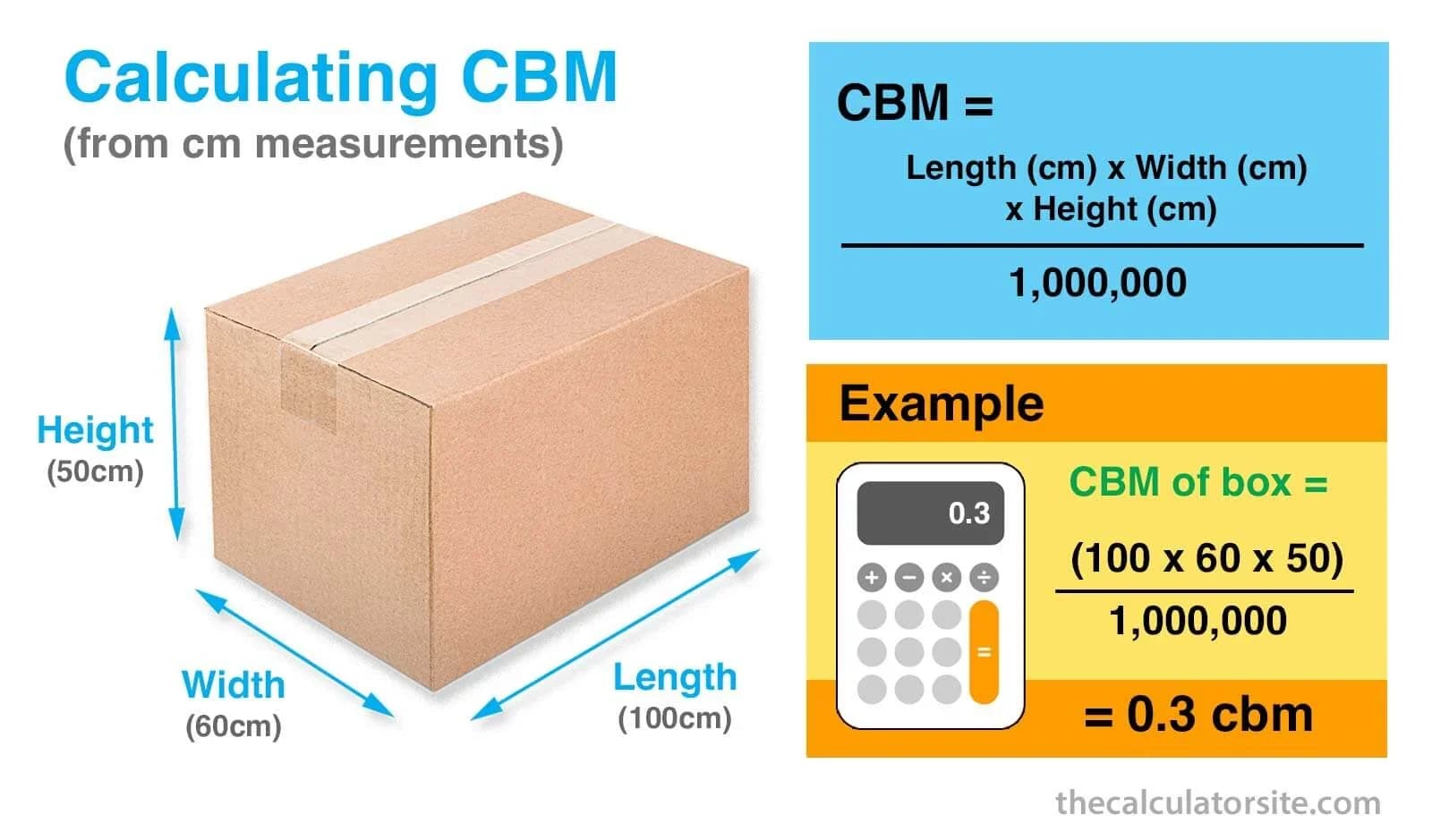
Convert all box dimensions to meters, multiply them to get the volume of a single box, and then multiply by the total number of boxes to get the total CBM.

Formula Used:CBM = [Length (m) × Width (m) × Height (m)] × Quantity

Step-by-Step Calculation Example

If you have 10 boxes, each measuring 50 cm × 40 cm × 30 cm: 0.5m × 0.4m × 0.3m = 0.06 CBM. Total CBM = 0.06 × 10 = 0.6 CBM.

Inputs and Assumptions

Enter values that match your project or situation. The calculator uses the following fields and defaults; update them before relying on the estimate.

Length
Default: 50 cm
Width
Default: 40 cm
Height
Default: 30 cm
Dimension Unit
Default: cm
Quantity (Boxes)
Default: 20
Weight per box (Optional)
Default: 15 kg

Common Mistakes to Avoid

  • Mixing different dimension units without proper conversion.

Practical Use Cases

  • LCL shipping cargo
  • Container packing planning

Expert Tips

  • Add a 5% spacing allowance for carton stacking gaps.

CBM Freight Shipping, Weight Conversion & Container Volume Guide

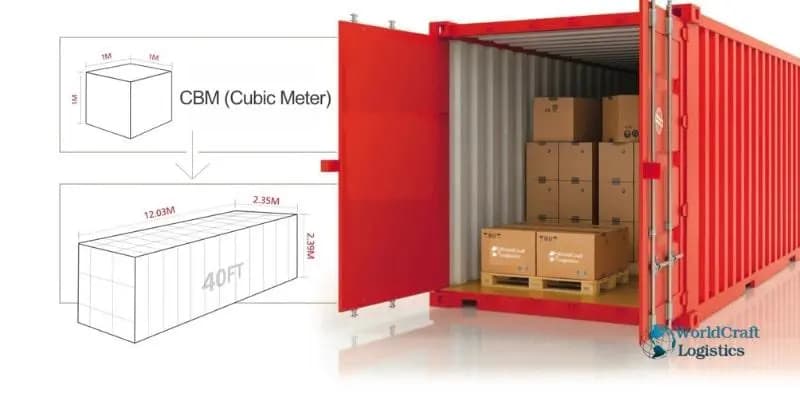
In international ocean and air freight logistics, CBM (Cubic Meters / m³) is the primary unit of measurement used to calculate cargo volume, container capacity utilization, and chargeable dimensional freight weight.

Whether you are shipping Less than Container Load (LCL), Full Container Load (FCL), or palletized air cargo, use our free CBM Shipping Calculator to compute volume across centimeters, inches, feet, and total carton counts.

Quick answer: convert each dimension to meters, multiply length by width by height, and multiply by the carton quantity. A 50 cm x 40 cm x 30 cm carton is 0.06 CBM; ten matching cartons are 0.60 CBM.

How to Calculate CBM from Any Unit of Measurement

From Centimeters (cm)

CBM = (L × W × H) ÷ 1,000,000

Example: 50×40×30 cm = 0.06 CBM
From Inches (in)

CBM = (L × W × H) ÷ 61,023.74

Example: 48×40×51 in = 1.605 CBM
From Feet (ft)

CBM = (L × W × H) ÷ 35.3147

Example: 4×4×4 ft = 1.812 CBM

For dimensions in millimeters, divide each measurement by 1,000 before multiplying. Equivalently, use CBM = (L mm × W mm × H mm) ÷ 1,000,000,000. Measure the outside of packed cartons, including any overhang, because that is the space a shipment occupies.

Calculate Total CBM From Shipping Dimensions

  1. Use one measurement unit for length, width, and height.
  2. Select that unit in the calculator and enter the outside dimensions of one carton or pallet.
  3. Enter the number of identical cartons to get total CBM and cubic feet.
  4. Compare the result with the carrier's quote, which may use actual weight, dimensional weight, a minimum charge, or all three.

CBM measures space, not mass. A CBM-to-kilogram ratio is a carrier billing convention, so confirm the divisor and any minimum charge with the freight provider before booking.

CBM to Kilograms (KG) Chargeable Weight Rules

Freight carriers calculate shipping costs based on Chargeable Weight, which is the higher number between actual gross scale weight and dimensional volumetric weight:

Shipping Mode1 CBM Weight Equivalent0.4 CBM Chargeable Weight0.6 CBM Chargeable Weight
Ocean LCL Freight1 CBM = 1,000 kg (1 Ton)400 kg600 kg
Standard Air Cargo (IATA)1 CBM = 167 kg (1:6)66.8 kg100.2 kg
Express Courier (DHL/FedEx)1 CBM = 200 kg (1:5)80.0 kg120.0 kg

Standard Pallet & Crate Dimension Reference Table

Cargo / Pallet TypeDimensions (Inches)Total Cubic InchesVolume in CBM
Standard GMA Pallet (Loaded)48″ × 40″ × 51″97,920 in³1.605 CBM
Oversized Machinery Crate67″ × 41″ × 59″162,073 in³2.656 CBM
High-Cube Master Skid68″ × 70″ × 96″456,960 in³7.488 CBM
Standard Master Parcel Carton24″ × 18″ × 16″6,912 in³0.113 CBM

Standard Ocean Container Capacity Reference Table

Container TypeInternal Dimensions (L × W × H)Max Volume CapacityUsable Practical CBM
20ft Standard (20GP)5.89m × 2.35m × 2.39m33.2 CBM28 – 30 CBM
40ft Standard (40GP)12.03m × 2.35m × 2.39m67.6 CBM58 – 62 CBM
40ft High Cube (40HQ)12.03m × 2.35m × 2.69m76.2 CBM68 – 70 CBM

Disclaimer

This calculation tool is provided for educational and informational estimation purposes only. Results are based on mathematical formulas and user-supplied parameters. They do not constitute formal underwriting, financial, tax, engineering, or legal determinations.

Frequently Asked Questions About CBM Shipping Calculator

What is CBM in shipping and how is it calculated?
CBM stands for Cubic Meter (m³), the universal volumetric measurement unit used in ocean and air freight logistics to calculate cargo volume, container capacity, and chargeable dimensional weight. The core formula is: Length (m) × Width (m) × Height (m) × Carton Quantity. Easily convert any unit using our free CBM Shipping Calculator.
How do I calculate CBM from dimensions in centimeters (cm)?
To calculate CBM from centimeter measurements, multiply Length (cm) × Width (cm) × Height (cm), then divide the result by 1,000,000: CBM = (L × W × H) ÷ 1,000,000. For example, a box measuring 60 cm × 40 cm × 50 cm equals 120,000 ÷ 1,000,000 = 0.12 CBM.
How do I calculate CBM from dimensions in inches?
To calculate CBM from inches directly, multiply Length (in) × Width (in) × Height (in), then divide by 61,023.74 (cubic inches in 1 cubic meter): CBM = (L × W × H) ÷ 61,023.74. For example, a standard 24″ × 18″ × 16″ carton equals 6,912 ÷ 61,023.74 = 0.113 CBM.
How do I calculate CBM from millimeters (mm)?
Multiply Length (mm) × Width (mm) × Height (mm), then divide by 1,000,000,000: CBM = (L × W × H) ÷ 1,000,000,000. For example, 500 mm × 400 mm × 300 mm equals 0.06 CBM. You can also convert each measurement to meters by dividing by 1,000 before multiplying.
How many kilograms (kg) is 1 CBM in sea freight vs. air freight?
In ocean freight (LCL shipping), the standard rule is 1 CBM = 1,000 kg (1 metric ton) of volumetric chargeable weight. In standard air cargo, the IATA volumetric ratio is 1 CBM = 167 kg (calculated as cubic cm ÷ 6,000 or cubic inches ÷ 366). For express couriers (DHL, FedEx, UPS), the ratio is 1 CBM = 200 kg (cubic cm ÷ 5,000).
What does 0.4 CBM or 0.6 CBM mean and how much weight does it represent?
A 0.4 CBM shipment represents 0.4 cubic meters (approx 14.12 cubic feet). In sea freight, 0.4 CBM equals a maximum volumetric chargeable threshold of 400 kg; in air cargo, it equals 66.8 kg. A 0.6 CBM shipment represents 21.19 cubic feet (600 kg sea freight / 100.2 kg air freight). Calculate your exact carton fits with our CBM Shipping Calculator.
How many CBM fit into standard 20ft, 40ft, and 40ft High Cube ocean containers?
A standard 20ft container (20GP) has a maximum capacity of 33.2 CBM, with a practical usable volume of 28 to 30 CBM. A 40ft container (40GP) has a total of 67.6 CBM (usable 58 to 62 CBM), and a 40ft High Cube container (40HQ) holds 76.2 CBM (usable 68 to 70 CBM).
What is the formula for converting CBM to cubic feet (cu ft) and cubic inches (cu in)?
1 CBM = 35.3147 cubic feet = 61,023.74 cubic inches = 1.30795 cubic yards. To convert CBM to cubic feet, multiply CBM by 35.3147. To convert cubic feet to CBM, divide cubic feet by 35.3147.
Is CBM the same as m³ (cubic meters)?
Yes. CBM and m³ are identical measurements. 'CBM' is the standard freight forwarding commercial acronym, while 'm³' is the international SI metric symbol for cubic meters.
Does CBM include the weight of my shipment?
No. CBM measures the physical space occupied by cargo, not its actual weight. Freight providers may compare actual weight with a dimensional-weight rule to set the chargeable weight, and their divisor, minimum charges, and rounding rules vary. Use the CBM Shipping Calculator for volume, then confirm the billing method with your carrier or forwarder.
Atlas Keller portrait
Editorial contact: Atlas Keller
Editorial policyEstimate only