
How to Calculate CBM for Shipping: Container Volume Guide

Quick Answer:
To calculate the CBM (Cubic Meters) of a box, multiply Length × Width × Height (in meters), then multiply by the total number of cartons. If measurements are in centimeters, divide total cubic cm by 1,000,000. If in inches, divide total cubic inches by 61,023.7.
In international trade, ocean freight, air cargo, and e-commerce fulfillment, freight charges are heavily determined by volume rather than raw weight alone. Whether you are importing goods from Alibaba, shipping Amazon FBA inventory, or booking a Less than Container Load (LCL) consignment, understanding how CBM is calculated is essential to avoid surprise freight invoices, optimize container space, and determine accurate shipping costs.
What is CBM (Cubic Meter) in Shipping?
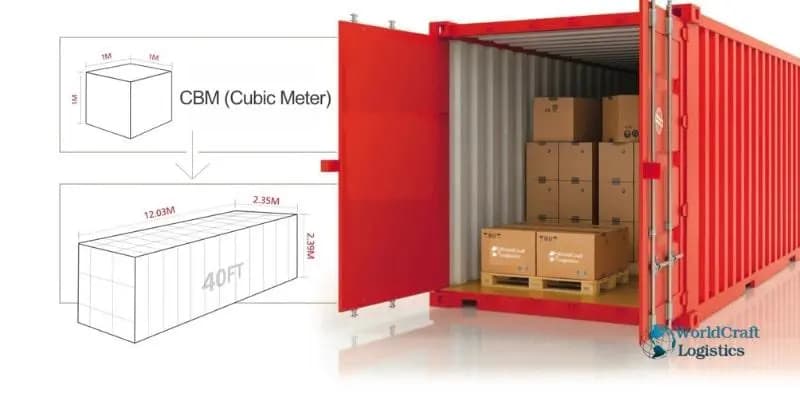
CBM stands for Cubic Meter, a standard unit of metric measurement used worldwide to quantify freight cargo volume. One CBM represents a three-dimensional cube measuring 1 meter long, 1 meter wide, and 1 meter high (1m × 1m × 1m = 1 m³).
Freight forwarders, shipping lines, and courier carriers use CBM as the primary metric for pricing LCL (Less than Container Load) shipments. In ocean freight, 1 CBM is often the minimum billable unit. If your cargo volume measures 0.4 CBM, most carriers will still bill you for a minimum threshold of 1 CBM.
How CBM is Calculated: The Core Volume Formula
When asking "how do I calculate CBM for my shipment?", the mathematical approach depends on your dimension unit. The fundamental physical formula for rectangular cartons is:
CBM = Length × Width × Height × Total Quantity
Formula 1: Direct Meters Calculation
CBM = Length (m) × Width (m) × Height (m) × Quantity
Formula 2: Centimeters to CBM Conversion
CBM = [Length (cm) × Width (cm) × Height (cm) ÷ 1,000,000] × Quantity
Formula 3: Inches to CBM Conversion
CBM = [Length (in) × Width (in) × Height (in) ÷ 61,023.7] × Quantity
Step-by-Step: How to Calculate CBM from Centimeters and Inches
Let's compare how you can calculate CBM when your supplier provides box dimensions in metric or imperial measurements:
Case 1: Calculate CBM from Centimeters
Suppose you are ordering 50 master cartons from an overseas supplier. Each box measures 60 cm long, 40 cm wide, and 30 cm high.
- Multiply Box Dimensions: 60 cm × 40 cm × 30 cm = 72,000 cubic centimeters (cm³).
- Convert to Cubic Meters: 72,000 ÷ 1,000,000 = 0.072 CBM per box.
- Multiply by Quantity: 0.072 CBM × 50 boxes = 3.6 CBM total volume.
Case 2: Calculate CBM Inches
If your warehouse specs specify carton sizes in imperial inches—for example, 24 inches long by 16 inches wide by 12 inches high for 50 boxes:
- Calculate Cubic Inches: 24 in × 16 in × 12 in = 4,608 cubic inches (in³).
- Divide by 61,023.7: 4,608 ÷ 61,023.7 ≈ 0.0755 CBM per box.
- Total Shipment Volume: 0.0755 CBM × 50 boxes = 3.775 CBM total volume.
CBM to KG Calculator: Volumetric Weight vs. Actual Weight
A common pitfall in shipping logistics is confusing gross actual weight with volumetric (dimensional) weight. Freight carriers bill based on whichever value is higher—this is known as the Chargeable Weight.
Standard Freight Volumetric Ratios:
- Ocean Freight (LCL): 1 CBM = 1,000 kg (1 Tonne). Ratio = 1:1,000.
- Air Freight: 1 CBM = 167 kg. DIM Factor = 6,000 (Length × Width × Height in cm ÷ 6,000).
- Courier / Express (DHL, FedEx, UPS): 1 CBM = 200 kg. DIM Factor = 5,000 (Length × Width × Height in cm ÷ 5,000).
For example, if you ship light foam pillows with a total volume of 5 CBM that weigh only 150 kg in actual weight:
- In Sea Freight LCL: 5 CBM equals 5,000 kg volumetric weight. Since 5,000 kg > 150 kg, you will be billed for 5 CBM (5 tonnes equivalent).
- In Air Freight: 5 CBM × 167 kg/CBM = 835 kg volumetric weight. Your chargeable weight is 835 kg, not 150 kg.
Container Loading CBM Math: 20ft vs. 40ft vs. 40ft HQ Capacity
When transitioning from LCL to Full Container Load (FCL), understanding container maximum volume vs. practical usable CBM is crucial. Because boxes cannot bend, pallets leave gaps, and loading doors consume clearance space, you can never utilize 100% of a container's theoretical volume.
| Container Type | Max Theoretical Volume | Usable Practical CBM | Max Cargo Weight |
|---|---|---|---|
| 20ft Standard Container | 33.2 CBM | 28.0 - 29.0 CBM | 25,000 kg |
| 40ft Standard Container | 67.7 CBM | 56.0 - 58.0 CBM | 27,600 kg |
| 40ft High Cube (HQ) | 76.4 CBM | 66.0 - 68.0 CBM | 28,600 kg |
Practical Freight Example: LCL Shipping Calculation
Imagine an e-commerce seller importing 120 cartons of products. Each carton has dimensions of 55 cm × 35 cm × 40 cm and weighs 12 kg per carton.
- Single Carton CBM: 0.55m × 0.35m × 0.40m = 0.077 CBM per carton.
- Total CBM: 0.077 CBM × 120 = 9.24 CBM.
- Actual Weight: 120 × 12 kg = 1,440 kg.
- Ocean LCL Chargeable Weight: 9.24 CBM is equivalent to 9.24 tonnes (9,240 kg volumetric weight). Billed weight is 9.24 CBM.
- Container Choice: Since 9.24 CBM is well below the 28 CBM threshold of a 20ft container, LCL ocean freight is significantly more economical than renting an entire 20ft container (FCL).
Logistics & Small Business Reddit Community Insights
Logistics managers and e-commerce importers on Reddit frequently discuss real-world packing inefficiencies, dead space, and freight forwarder billing quirks.
In a popular thread on logistics, logistics veteran cargo_pro highlights: "Never assume you can fit 33 CBM into a 20ft container. Unless your cartons are custom-designed to match the exact interior height and width of the container without pallets, you will lose 10% to 15% to dead space. Realistically, plan for 28 CBM."
Discussing freight calculation software on smallbusiness and Alibaba, user supply_chain_dev notes: "When calculating container fit, remember pallet height! A standard US pallet adds 5.5 inches of height. If you don't factor in pallet dimensions alongside carton CBM, your top layer of boxes won't clear the container ceiling."
Furthermore, on SupplyChainEducation and logistics, freight specialists caution: "Always re-measure your cartons after they are packed and taped. Cardboard bulges on the sides when crammed full, adding 1 to 2 cm per dimension. That bulge can increase your final billed CBM by 8%!"
Sources and Community References
- Reddit logistics container loading thread: logistics - CBM Calculations for Container Loading
- Reddit smallbusiness container fit discussion: smallbusiness - Free CBM & Container Fit Calculators
- Reddit SupplyChainEducation volume vs weight math: SupplyChainEducation - How to Calculate CBM
- Reddit Alibaba container loading calculator thread: Alibaba - Container Loading Math
- Reddit ecommerce freight recommendations: ecommerce - E-commerce Logistics Solutions
- Reddit SupplyChainLogistics shipping calculations: SupplyChainLogistics - CBM Shipping Math
- Reddit calculators cubic meter discussion: calculators - Cubic Meter Calculator Formulas
- Reddit logistics volumetric weight calculation thread: logistics - Volumetric Weight Calculation Guide
- Reddit FulfillmentByAmazon container software discussion: FulfillmentByAmazon - Container Loading Optimization
Atlas Keller's editorial scope covers Infinix material-volume, coverage, and construction planning content. Quantities and costs are estimates, not engineering specifications or supplier quotes.