
How Many Bags of Concrete Do I Need? Slabs & Post Math

Quick Answer:
To find the number of bags of concrete required, divide the total volume needed (in cubic feet) by the bag's yield. A standard 80lb bag yields 0.60 cubic feet (45 bags per cubic yard), while a 60lb bag yields 0.45 cubic feet (60 bags per cubic yard).
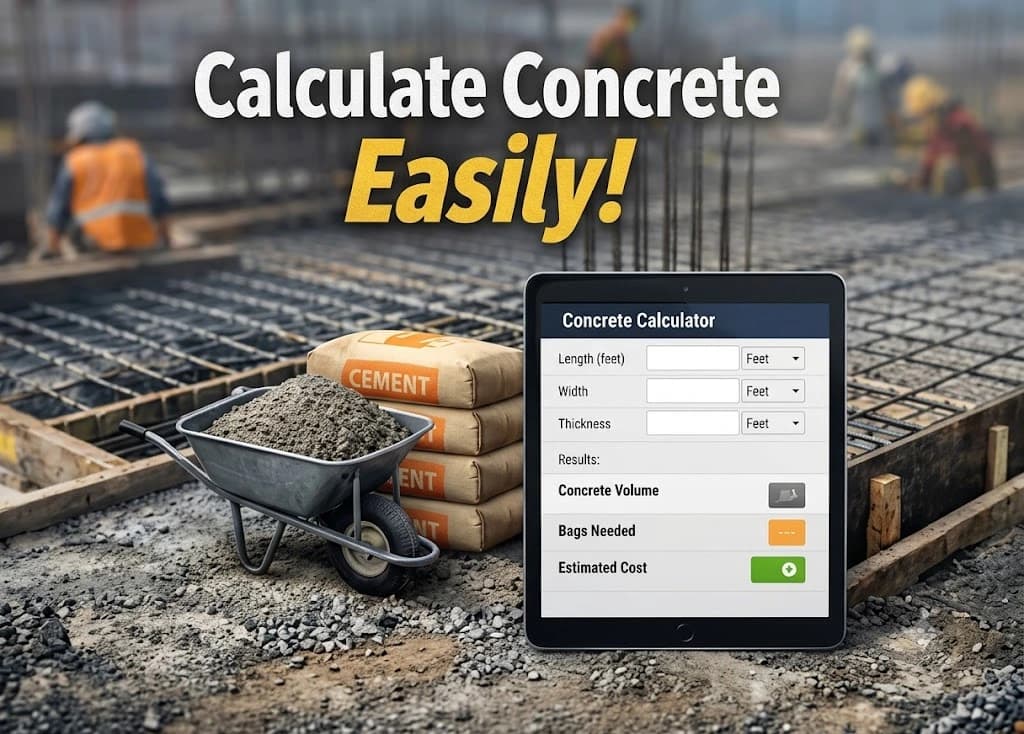
Planning a backyard patio slab, setting fence posts, or pouring structural deck piers is an exciting home upgrade. However, the most critical step before picking up a shovel is ordering the correct amount of material. Underestimating your concrete means your pour will cure with cold joints, compromising structural strength. Overestimating means you'll have paid for heavy bags that you have to load back into your car. This guide explains how to calculate concrete volume using our Concrete Calculator, compares bag yields, and calculates columns and post settings.
How to Calculate Concrete Volume: Cubic Feet to Yards
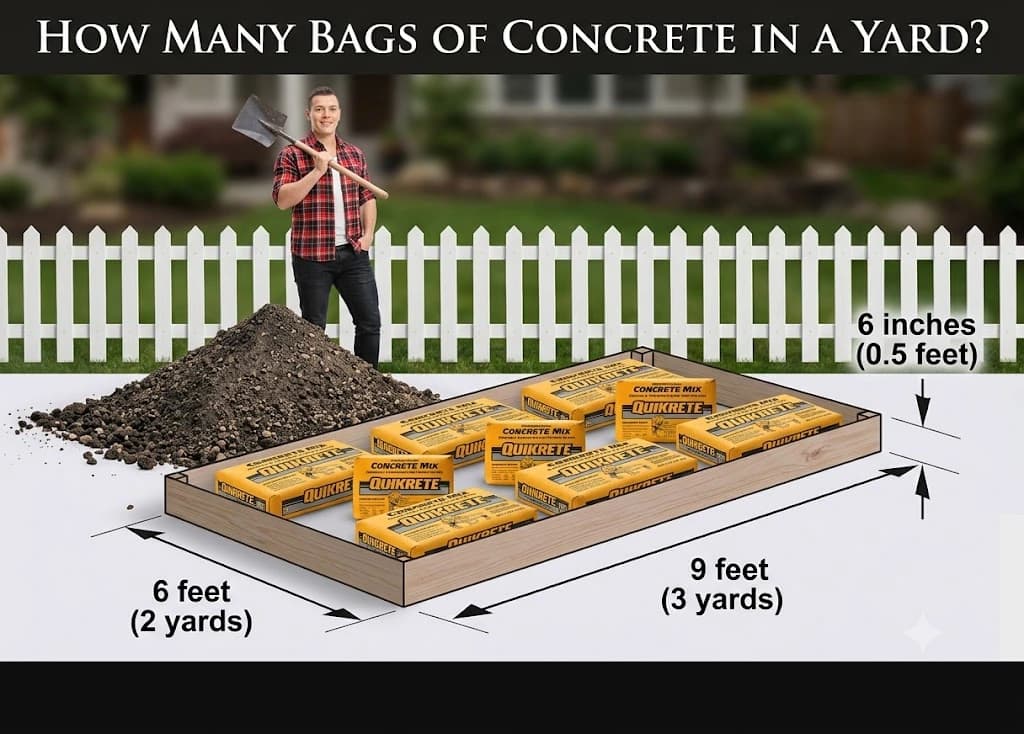
Concrete is measured and sold by two metrics: cubic feet (for pre-mixed bags purchased at home centers) and cubic yards (for wet concrete delivered by ready-mix dump trucks). To calculate the volume required for any rectangular structure, use the following formula:
Volume (Cubic Feet) = Length (ft) × Width (ft) × [Thickness (inches) ÷ 12]
Once you calculate the total in cubic feet, you can convert it to cubic yards (which is how concrete suppliers price bulk deliveries) by dividing the cubic feet by 27:
Cubic Yards = Cubic Feet ÷ 27
Concrete Bag Yields: 40lb, 60lb, and 80lb Math
If you choose to mix the concrete yourself using bagged pre-mix (like Quikrete or Sakrete), you must convert your volume requirements into a bag count. Different bag sizes yield different volumes of wet concrete:
- 80-Pound Bag: Yields exactly 0.60 cubic feet. You need 45 bags to make one cubic yard.
- 60-Pound Bag: Yields exactly 0.45 cubic feet. You need 60 bags to make one cubic yard.
- 40-Pound Bag: Yields exactly 0.30 cubic feet. You need 90 bags to make one cubic yard.
If you purchase by the pallet, a typical pallet of 80lb concrete contains 42 bags (approx. 0.93 cubic yards). A pallet of 60lb concrete contains 56 bags (approx. 0.93 cubic yards).
Calculating Bags Needed for a Rectangular Concrete Slab
Let's run a practical example: You want to pour a patio slab that is 10 feet long, 10 feet wide, and 4 inches thick. How many bags of concrete do you need?
- Convert thickness to feet: 4 inches ÷ 12 = 0.33 feet.
- Calculate volume in cubic feet: 10 × 10 × 0.33 = 33.3 cubic feet.
- Calculate bags required:
- If using 80lb bags: 33.3 ÷ 0.60 = 56 bags (plus 10% waste margin = 62 bags).
- If using 60lb bags: 33.3 ÷ 0.45 = 74 bags (plus 10% waste margin = 82 bags).
Always add a **10% spillage and waste margin** to your calculations to account for uneven subgrades, mixing container residue, and spillage.
Fence Posts and Cylindrical Columns (Sonotubes)
Calculating concrete for fence posts or deck piers requires calculating cylinder volumes. The volume of a cylinder is calculated as follows:
Cylinder Volume = π × Radius² × Depth
For example, if you are setting an 8-foot 4x4 fence post (which has a physical dimension of 3.5" × 3.5"), the standard rule of thumb is to dig a hole that is three times the width of the post (12 inches diameter) and 3 feet deep.
- Hole radius = 6 inches (0.5 feet).
- Total hole volume = π × 0.5² × 3 = 2.35 cubic feet.
- Subtract post volume inside the hole: 0.29 × 0.29 × 3 = 0.25 cubic feet.
- Net concrete needed per hole = 2.10 cubic feet (approx. 3.5 bags of 80lb concrete per post).
Reddit DIY Hacks: Mixing Bags vs. Pallets
In DIY spaces like Concrete and FenceBuilding, homeowners share practical limits on mixing bags manually.
As user slab_pro notes: "If your calculator shows you need more than 30 bags of 80lb concrete, do not try to mix them in a wheelbarrow with a hoe. You will be exhausted, the first batch will start setting before you finish the last batch, and you will end up with structurally weak cold joints. Rent a motorized mixer or call a ready-mix truck."
For fence building, user gate_maker advises: "When setting post holes in frost-heavy areas, ensure you dig the bottom of the hole wider than the top (bell-shaped). If you make the top wider, frost will grab the concrete collar and push your fence post straight out of the ground."
Sources and Community References
- Reddit Concrete community discussion on calculator tools: Concrete - Calculator Tool Advice
- Reddit FenceBuilding discussion on post depth and concrete quantities: FenceBuilding - Post Depth and Concrete Math
Atlas Keller's editorial scope covers Infinix material-volume, coverage, and construction planning content. Quantities and costs are estimates, not engineering specifications or supplier quotes.