
The Mortgage Payoff Game: How to Win, Save Thousands, and Gamify Your Debt

Quick Answer:
To "beat" the mortgage game, you must reduce the compounding effect of interest. Adding just 1/12th of your standard monthly payment as an extra principal payment each month (which equals one extra full payment per year) shaves approximately 4 to 5 years off a standard 30-year mortgage and saves tens of thousands of dollars in lifetime interest.
For most homeowners, a mortgage is the largest financial liability they will ever take on. Paying a monthly mortgage bill for 30 years can feel like an endless uphill battle. However, a growing movement of personal finance enthusiasts, teachers, and software developers are choosing to look at amortization schedules differently: as a game. By gamifying your debt, you can transform a boring monthly bill into an engaging financial challenge that saves you thousands of dollars.
Introduction: What is the Mortgage Game?
The "Mortgage Game" refers to the strategies homeowners use to minimize the total amount of interest paid to the bank and shorten their loan term. It is a game played against compound interest. On standard 30-year fixed mortgages, the bank structures the loan so that in the early years, the vast majority of your monthly payment goes toward interest, while very little goes toward reducing the principal balance. The goal of the game is to disrupt this amortized schedule, converting interest charges into home equity as quickly as possible.
In classroom settings, teachers frequently use interactive debt calculators to teach high school students about the mechanics of home buying. Citing recommendations on the Teachers subreddit, educators emphasize that students are often shocked to learn that a $300,000 home can cost over $600,000 in total payments over 30 years due to interest. Gamifying these calculations using interactive sliders helps teens visualize the real-world value of making extra payments and maintaining strong credit scores.
Prepaying vs. Investing: The FIRE Perspective
One of the oldest debates in the personal finance community is whether you should make extra payments to pay off your mortgage early or invest that extra cash in the stock market instead. In the Financial Independence, Retire Early (FIRE) community, this is referred to as the prepaying vs. investing trade-off.
As discussed on the Fire community thread, members evaluate this debate by looking at the "guaranteed rate of return." If your mortgage interest rate is 6.5%, prepaying your mortgage principal provides a guaranteed, risk-free 6.5% return on that money, as you avoid future interest charges. In contrast, investing in an index fund (like the S&P 500) offers a historically higher but variable return (around 8% to 10% long-term), which is subject to market volatility. The thread also highlights a psychological factor: for many in the FIRE movement, the peace of mind of having a fully paid-off home outweighs the theoretical marginal gain of investing in stocks, as it dramatically lowers their monthly baseline living expenses in retirement.
The Math: The Most Efficient Way to Prepay
If you decide to make extra payments on your mortgage, when and how should you make them to maximize your savings? The math behind amortization curves shows that time is your biggest variable.
According to analysis on the RealEstate forum, the mathematically most efficient time to make extra payments is during the **first 5 to 7 years** of the mortgage. Because your principal balance is at its highest during this initial phase, the monthly interest accrued is also at its peak. Any extra dollar applied to the principal early on immediately stops that dollar from accruing interest for the remaining 25+ years of the loan. Front-loading extra payments has a massive compounding effect, whereas making extra payments in Year 25 of a 30-year mortgage has a negligible impact on your overall interest savings.
Gamifying Debt: Classrooms, Simulators, and Apps
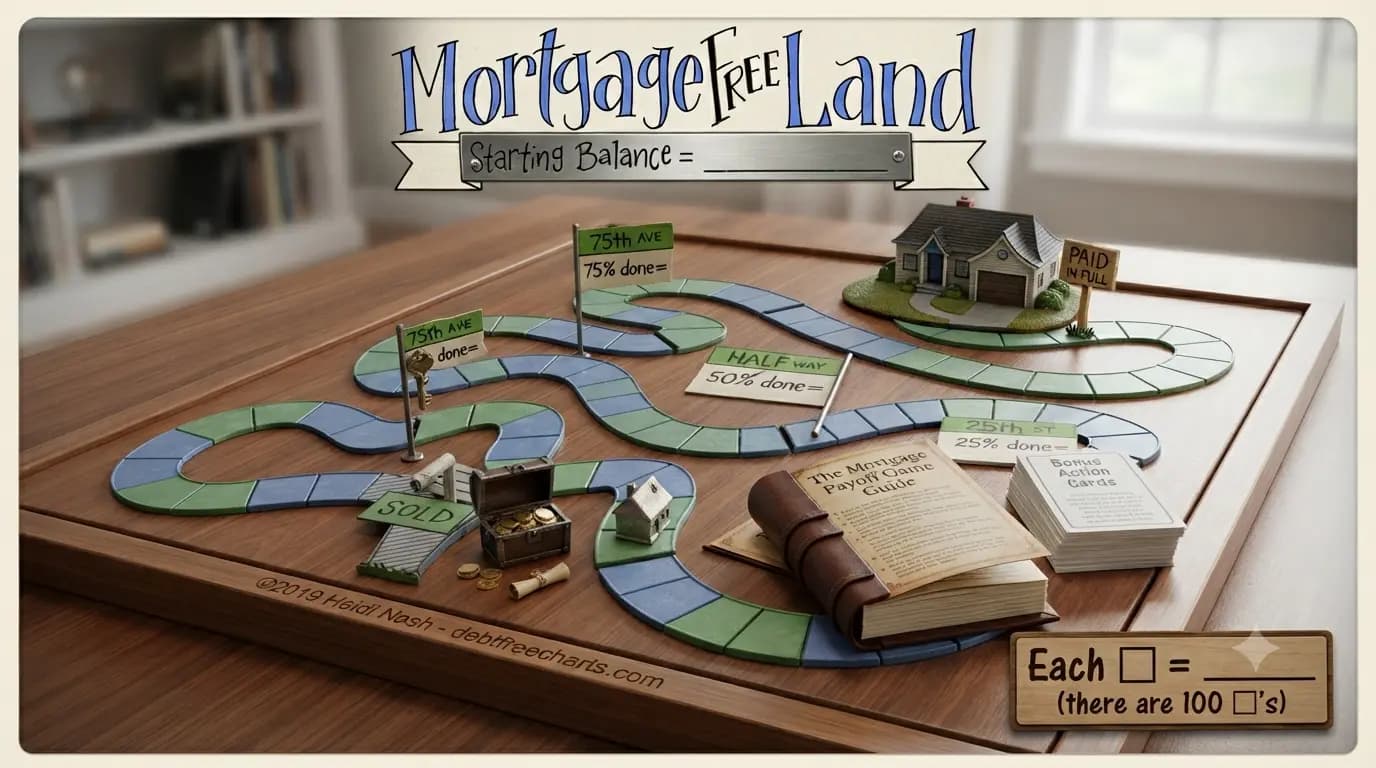
Because looking at raw numbers on a spreadsheet can be boring, programmers and developers have turned to gamification. By building visual tools, they make debt paydown feel like a video game where you watch your progress bar fill up and unlock achievements.
For example, on the rails subreddit, software developers share interactive mortgage simulators built to visually map out amortization timelines. Similarly, on iOSProgramming, developers describe releasing mobile apps that turn mortgage payoff schedules into a game, complete with progress circles and visual milestone badges. Even board game designers leverage these concepts; on boardgames and tabletop roleplaying boards like traveller, players manage complex cash flows and ship mortgages, proving that managing interest rates and loan payments can be an entertaining puzzle when presented as a game.
How to Beat the Mortgage Game: Actionable Strategies
To win the mortgage game and shorten your timeline, you can employ several proven repayment strategies:
- The Bi-Weekly Payment Strategy: Instead of making one monthly payment, make half of your monthly payment every two weeks. Because there are 52 weeks in a year, you will make 26 half-payments. This adds up to 13 full payments per year (one extra full payment annually), automatically shaving 4 to 5 years off a 30-year term.
- The 1/12th Rule: Take your standard monthly principal and interest payment, divide it by 12, and add that amount as an extra principal payment every month. This achieves the same interest-saving result as the bi-weekly method but is easier to manage on a standard monthly budget.
- Lump-Sum Infusions: Apply unexpected windfalls (such as tax refunds, annual job bonuses, or inheritance cash) directly to your mortgage principal. Citing discussions on personalfinance, users remind borrowers: "Always contact your lender or specify in your payment portal that the extra money should be applied strictly to the principal balance, not toward your next month's standard payment."
- Verify with a Game: To model these extra payments and see exactly how many years you can save, try out our interactive Mortgage Calculator Game. It estimates your interest savings and awards a custom financial score based on your payoff speed.
Sources and Community References
- Reddit FIRE community discussion on treating principal payments as savings or expenses: Fire - Mortgage Principal in Net Worth
- Reddit Rails community thread showcasing a custom mortgage simulator: rails - Amortization Simulator Project
- Reddit iOS Programming thread on mortgage gamification mobile apps: iOSProgramming - Gamifying Debt Mobile App
- Reddit Boardgames thread exploring finance and debt mechanics in games: boardgames - Finance and Mortgage Games
- Reddit Traveller community discussion on spacecraft mortgage calculations: traveller - Ship Mortgage Math
- Reddit Personal Finance NZ thread on mortgage calculators and interest: PersonalFinanceNZ - Interest Calculations
- Reddit Teachers thread discussing personal finance games for high schoolers: Teachers - Financial Calculators for Teens
- Reddit Personal Finance community thread on prepaying mortgages: personalfinance - How to Beat the Mortgage Game
- Reddit Real Estate discussion on the mathematical efficiency of extra payments: RealEstate - Efficient Mortgage Prepayments
- Reddit First Time Home Buyer thread analyzing online mortgage calculators: FirstTimeHomeBuyer - Mortgage Calculator Accuracy
Vaughn Mercer's editorial scope covers Infinix finance, tax, payroll, and payment-fee content. Estimates are educational and do not constitute financial or tax advice.