
Should I Retake the LSAT? Calculate Your Score Improvement and Admissions Chances

Quick Answer:
Yes, you should retake the LSAT if your practice scores are higher than your official score. Because law schools only report and care about your highest score, there is no admissions downside to retaking. Repeat test-takers gain an average of 2.5 to 3 scaled points.
You received your official score, but it isn't quite where you wanted it to be. The panic sets in: should I retake the LSAT? Will law schools think less of my application if I take it a second or third time? Fortunately, the modern admissions landscape is highly supportive of retakes. Making a data-backed decision can save you tens of thousands of dollars in tuition.
Why Law Schools Only Care About Your Highest Score
There is a widespread myth that law schools average your LSAT scores. In the past, this was true. However, in 2006, the American Bar Association (ABA) changed its rules, and U.S. News & World Report aligned its rankings methodology to match. Today, law schools are evaluated and ranked based exclusively on the highest LSAT score of their entering class.
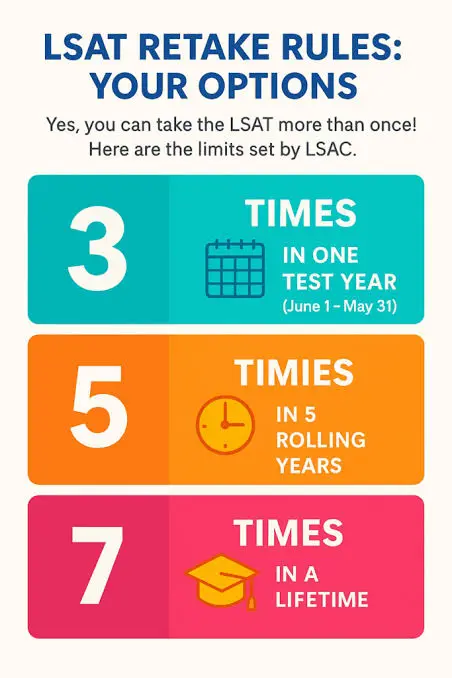
Because admissions offices want to maximize their median scores to climb the rankings, they have no incentive to penalize you for multiple attempts. If you score a 155 on your first try and a 163 on your second, law schools will report and evaluate you as a 163. There is virtually no admissions downside to retaking the exam if you believe you can improve. Deciding whether to retake the LSAT requires understanding retake limitations. According to the official LSAC Test Attempt Limits, candidates can take the LSAT up to five times within five years.
Calculate Your Score Differences
Want to see how many fewer questions you need to miss to hit your target scaled score? Use our LSAT Score Calculator to experiment with different raw section scores and find your target conversion rate.
Start LSAT CalculationThe Math of Retaking: Average Score Improvements
According to historical data published by the Law School Admission Council (LSAC), the average score increase for repeat test-takers is 2.5 to 3 scaled points. However, this average includes students who did not modify their study habits. If you analyze your diagnostic performance and adjust your approach, larger gains are very common.
| Initial Scaled Score | Average Retake Gain | Admissions & Scholarship Impact |
|---|---|---|
| 140 - 149 | +4 to +6 points | Moves from below average to solid regional competitiveness. |
| 150 - 159 | +3 to +4 points | Often triggers significant merit-based scholarships. |
| 160 - 165 | +2 to +3 points | Can elevate an applicant into top-50 and top-30 schools. |
| 166 - 170 | +1 to +2 points | The threshold change needed to access elite T14 schools. |
A Decision Framework: When to Retake vs. When to Apply
How do you know if a retake is right for you? Ask yourself these critical questions:
- Are your practice test scores higher than your official score? If you regularly scored a 165 in practice but got a 160 on test day due to nerves or technical glitches, you should retake. Your practice scores indicate your true potential.
- Did you run out of preparation time? If you rushed your study schedule and only completed half of your preparation materials, an extra 2 months of structured study can yield a significant score increase.
- Where do you stand relative to school medians? If your target school has an LSAT median of 162 and you scored a 159, retaking to get those extra 3 points is the single best action you can take to secure admission.
On the LSAT forum, users debate the value of a retake. As user retake_champion notes in community threads: "If you have a clear plan to adjust your prep methodology and are scoring higher on practice tests, a retake is always worth it. Law schools generally look at your highest score, not the average of multiple attempts, making a retake low-risk."

How to Adjust Your Strategy for a Higher Attempt
If you decide to retake, do not simply repeat the same study habits. You must adjust your approach:
- Analyze Your Score Report: Identify if Logical Reasoning or Reading Comprehension dragged down your score. Target your weakest sections with focused drills.
- Simulate Exact Testing Environments: Take practice tests in a quiet room, online, using the strict 35-minute timing structure and the official 10-minute break. This builds the stamina required for test day.
- Use Conversion Curves: Keep track of your section errors to see how your raw correct answers convert on different practice test scales.
Sources and Community References
- Official LSAC Policy on LSAT Test Attempt Limits: LSAC - Testing Attempt Policy Limits
- Reddit LSAT community discussion on retake score improvements and averages: LSAT - Retake Strategies & Study Methods
Rowan Vance's editorial scope covers Infinix mathematics, unit conversions, ratings, and educational scoring guides. No university or testing-agency affiliation is claimed.