
Human Calculators, Digital Tools & The AI Debate: Speed, Math & Accuracy

Executive Summary & Key Takeaways:
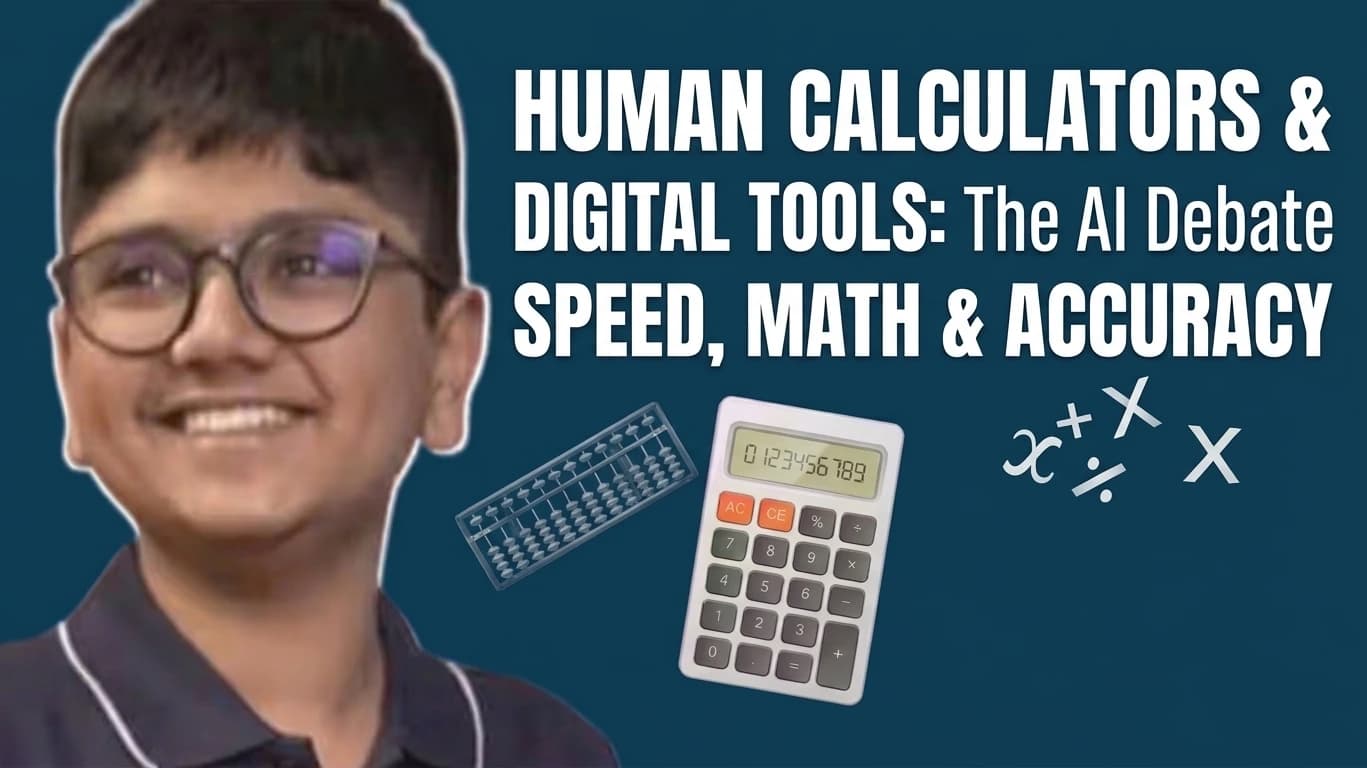
In February 2025, 14-year-old Aaryan Shukla set six Guinness World Records in Dubai by mentally adding 50 five-digit numbers in 18.71 seconds. Yet while human calculators push the boundaries of working memory, the rise of artificial intelligence has reignited the classic 1980s calculator debate: does technological automation destroy human skills or elevate them? Crucially, digital calculators remain 100% deterministic (infallible math logic), whereas AI LLMs are probabilistic engines that require deterministic verification.
Human mental calculation has fascinated humanity for centuries. Videos of child prodigies computing 8-digit multiplications or 5th roots in seconds regularly go viral online. However, as artificial intelligence models (LLMs) take over computer programming and analytical drafting, educators and engineers are grappling with a profound question: Is using AI today no different than using a calculator in 1985, or is there a fundamental flaw in comparing probabilistic language models to deterministic computing engines?
2025 Guinness World Records: Inside Aaryan Shukla's Feats
The global benchmark for human calculation was dramatically rewritten in February 2025. As officially documented by Guinness World Records (February 2025 Report), 14-year-old Indian prodigy Aaryan Shukla set six world records in a single day during a special adjudicating event in Dubai:
Aaryan Shukla's 6 World Records (Dubai 2025):
- Fastest addition of 50 5-digit numbers: 18.71 seconds (approx. 0.37 seconds per 5-digit sum!).
- Fastest addition of 100 4-digit numbers: 30.90 seconds.
- Fastest addition of 200 4-digit numbers: 1 minute 9.68 seconds.
- Fastest division of 20-digit by 10-digit numbers (10 problems): 5 minutes 42 seconds.
- Fastest multiplication of two 5-digit numbers (10 problems): 51.69 seconds.
- Fastest multiplication of two 8-digit numbers (10 problems): 2 minutes 35.41 seconds.
When asked how his mind processes these staggering sums at sub-second speeds, Aaryan explained: "A lot of things in mental calculations happen in a flash of a second, so I cannot say what happens inside my head... I just do it naturally. It's so fast that you can't think, you just need to do the calculations." Beyond his world records, Aaryan is a founding board member of the Global Mental Calculators Association (GMCA), advocating for mental arithmetic training worldwide.
The Science of Human Calculators: Soroban & Trachtenberg
Human calculators do not perform standard longhand column arithmetic taught in primary schools. Instead, they rely on specialized cognitive algorithms and working memory expansion techniques:
1. Soroban Anzan (Mental Abacus)
Practitioners visualize a physical Japanese Soroban abacus inside their mind's eye. By manipulating virtual beads in the brain's right hemisphere, calculation is transformed into spatial pattern movement, bypassing verbal bottleneck processing.
2. The Trachtenberg System
Developed by Jakow Trachtenberg in WWII, this modular algorithmic framework eliminates standard multiplication tables. It uses direct digit-neighbor addition rules to perform rapid mental multiplication without scratchpad intermediate steps.
The 1980s Calculator Debate vs. The 2026 AI / LLM Controversy
The rise of generative AI has sparked intense debate across education and technology communities. Prominent discussions on Reddit explore whether AI assistance mirrors the historical adoption of handheld electronic calculators:
- In r/Teachers (AI vs. Calculators Debate), educators compare current cell phone and LLM policies to the 1980s ban on handheld Texas Instruments calculators in algebra classrooms.
- Technologists in r/artificial (The 1980s Calculator Debate & AI) note that in the 1970s and 1980s, critics claimed pocket calculators would make students incapable of basic math. Instead, calculators eliminated tedious long-division drills and enabled high schoolers to master calculus, trigonometry, and statistics.
- Discussions on r/unpopularopinion (LLMs vs. Coding) and r/singularity (Programmers and Calculator Evolution) argue that Large Language Models (LLMs) will shift software engineering from manual syntax writing to high-level architecture—just as calculators shifted math from manual long arithmetic to formula design.
- Ethical perspectives in r/aiwars (Skill Degradation vs. Automation) and r/aiwars (Hating AI vs. Hating Calculators) contend that adopting productivity tools is a natural evolutionary step in human capability.
Deterministic Accuracy vs. Probabilistic LLMs: Why Calculators Don't Hallucinate
Despite popular comparisons, treating Large Language Models as "calculators for text or code" overlooks a critical mathematical distinction analyzed in r/changemyview (Why the LLM-Calculator Analogy is Flawed) and r/changemyview (Calculators in Education):
The Core Distinction:
- Digital Calculators are 100% Deterministic: Built with hardware logic gates adhering to IEEE 754 arithmetic standards, a calculator will evaluate
12,458 × 8,932to111,274,856every single time. It never hallucinates, misinterprets intent, or offers a "plausible guess." - Generative LLMs are Probabilistic Engines: LLMs operate on token probability distributions. Without invoking external code execution or specialized calculator APIs, LLMs frequently make simple arithmetic errors because they are guessing the most probable next word rather than executing mathematical logic.
For high-stakes fields—such as payroll calculation (Square Merchant Fee Calculator), freight volume estimating (CBM Freight Calculator), or sales tax compliance (California Sales Tax Calculator)—relying solely on unverified LLM output is risky. Deterministic web calculators remain indispensable for exact verification.
Comprehensive Comparison: Mental Math vs. Digital Calculators vs. AI Engines
| Feature / Dimension | Human Calculators | Digital Web Calculators | Generative AI (LLMs) |
|---|---|---|---|
| Primary Mechanism | Soroban Anzan & Trachtenberg working memory | IEEE 754 deterministic silicon chips / JS engines | Probabilistic neural next-token prediction |
| Calculation Speed | Sub-second for trained arithmetic sums | Microseconds (instant) | Seconds (streaming response generation) |
| Accuracy & Hallucination | High (susceptible to human fatigue) | 100% Deterministic (Zero Hallucination) | Probabilistic (May hallucinate without tool calling) |
| Best Use Case | Mental agility, rapid estimation & competition | High-stakes finance, engineering & materials math | Context synthesis, code generation & drafting |
Verified News Records & Community Sources
- Guinness World Records (Feb 2025): Aaryan Shukla Shatters 6 Mental Maths Records
- Reddit r/Teachers: Classroom Discussion on AI vs. Handheld Calculators
- Reddit r/artificial: Why the 1980s Calculator Debate is Repeating with AI
- Reddit r/aiwars: Skill Automation vs. Mental Agility Debate
- Reddit r/singularity: Programmers and the Calculator Paradigm Shift
- Reddit r/unpopularopinion: LLMs Doing to Coding What Calculators Did to Math
- Reddit r/changemyview: Should Calculators Ever Be Artificially Banned?
- Reddit r/aiwars: Hating AI vs. Hating Handheld Calculators
- Reddit r/changemyview: Why the LLM-Calculator Analogy is Mathematically Flawed

Dr. Vance is a research mathematician and psychometric modeler specializing in standardized test scoring distributions, inverse trigonometry, and algebraic weighted averages.